 Friedman Rodman Frank & Estrada, P.A. Home
Motorcycle Accidents
Reviewed by Elizabeth Estrada, a Florida attorney who handles personal injury and wrongful death matters. Last updated July 29, 2026.
A Quick Reference Guide to Florida Motorcycle Accident Claims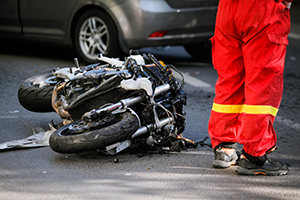 A motorcycle crash is decided under the same Florida negligence law as any other traffic collision, but riders sit outside the no-fault insurance system that covers drivers of cars. Florida Statute § 627.732(3) defines a "motor vehicle" for no-fault purposes as a self-propelled vehicle with four or more wheels, which leaves motorcycles out, so a rider has no automatic personal injury protection benefit paying the first medical bills.
- No PIP for riders: Because the no-fault definition in Florida Statute § 627.732(3) reaches only vehicles with four or more wheels, motorcycles are not covered, and there is no $10,000 first-party benefit waiting after a crash.
- Filing deadline: Two years from the date of the crash for causes accruing on or after March 24, 2023, under Florida Statute § 95.11(5)(a).
- Fault rule: Modified comparative negligence under Florida Statute § 768.81(6). A rider found more than 50 percent at fault recovers nothing.
- Governing standard: Ordinary negligence, requiring duty, breach, causation, and damages, as set out in Clay Electric Cooperative v. Johnson, 873 So. 2d 1182 (Fla. 2003).
- Helmet rule: Florida Statute § 316.211 requires protective headgear meeting Federal Motor Vehicle Safety Standard 218, except that a rider over 21 may go without if covered by an insurance policy providing at least $10,000 in medical benefits.
- Eye protection: The same statute requires an operator to wear department-approved eye protection, with no age or insurance exception.
- Shared fault: Joint and several liability is abolished, and under Florida Statute § 768.81(3) a jury assigns each party its own percentage of responsibility.
- Fatal crashes: A wrongful death claim is brought by the personal representative of the estate under Florida Statute § 768.20, with damages defined by Florida Statute § 768.21.
The motorcycle accident attorneys at Friedman Rodman Frank & Estrada represent riders throughout Miami-Dade and Broward Counties, from the firm's Miami office to the Homestead office serving South Dade.
Riders start these cases at a disadvantage that has nothing to do with how the crash happened. There is no personal injury protection benefit paying the first bills, so the financial pressure arrives immediately. And there is a durable assumption, which insurance adjusters know how to use, that a motorcyclist was probably going too fast or riding recklessly. We have represented injured riders across South Florida since 1976, including a $5.45 million recovery in a motorbike crash, and most of the early work in these cases is about replacing that assumption with evidence. For how fault, insurance, and deadlines work across Florida injury claims generally, see our South Florida personal injury practice.
Why Does Florida's No-Fault System Leave Riders Exposed?The no-fault statute was written around four-wheeled vehicles, and a motorcycle is not one. Florida Statute § 627.732(3) defines a "motor vehicle" as any self-propelled vehicle with four or more wheels, designed and required to be licensed for highway use. A two-wheeled motorcycle does not fit that definition. The personal injury protection requirement that applies to car owners therefore does not reach motorcycle owners, and a rider is not required to carry it.
The practical effect shows up in the first month. After a car crash, an injured driver has personal injury protection sitting behind them, paying medical bills regardless of who caused the collision, as our Miami car accident page explains. That benefit reaches $10,000 where a provider determines the driver had an emergency medical condition, and is capped at $2,500 where no such determination is made under Florida Statute § 627.736. A rider has nothing equivalent unless they bought health insurance, medical payments coverage, or uninsured motorist coverage on their own policy. Hospital bills after a serious motorcycle crash routinely pass six figures before anyone has established fault. That gap is why riders feel pressure to accept an early settlement offer, and it is why insurers make those offers early.
There is one thing the gap does not do, and it is worth being clear about. Not having personal injury protection does not weaken a rider's claim against the driver who caused the crash. If anything it simplifies it, because a rider does not have to clear the permanent-injury threshold that a car occupant must meet before stepping outside the no-fault system to sue. A rider's claim against the at-fault driver exists from the moment the crash happens.
How Do Florida's Fault Rules and Helmet Law Affect a Rider's Claim?Florida uses modified comparative negligence, and a rider found more than 50 percent at fault recovers nothing. This is the rule that most often decides motorcycle cases, and it changed recently enough that older material still gets it wrong. Before the 2023 reform Florida followed pure comparative negligence, under which an injured person could recover something even if they were overwhelmingly at fault. Florida Statute § 768.81(6) replaced that with a hard bar at 51 percent. A rider assessed at 50 percent recovers half their damages. A rider assessed at 51 percent recovers nothing at all.
Florida negligence law requires four elements: a duty of care, a breach of it, causation, and damages, as the Florida Supreme Court set out in Clay Electric Cooperative v. Johnson, 873 So. 2d 1182 (Fla. 2003). Apportionment then runs on top of those elements rather than replacing them. Under Florida Statute § 768.81(3), a jury assigns each responsible party a percentage of the total, joint and several liability no longer applies, and a defendant may place fault on someone who is not a party to the lawsuit at all. In a motorcycle case the percentage argument is usually the whole fight, since insurers rarely dispute that the rider was badly hurt.
The helmet question feeds directly into that percentage. Florida Statute § 316.211 requires a person operating or riding on a motorcycle to wear protective headgear complying with Federal Motor Vehicle Safety Standard 218, but a person over 21 may ride without a helmet if covered by an insurance policy providing at least $10,000 in medical benefits.
A rider over 21 with that coverage is riding lawfully. Insurers still raise the point, arguing that the absence of a helmet contributed to a head injury, which is an argument about the rider's share of fault under Florida Statute § 768.81 rather than about whether the rider broke the law. The eye-protection requirement in the same statute has no such exception and applies to every operator.
What Damages Can an Injured Rider Recover in Florida?Both economic and noneconomic damages, with no statutory cap in an ordinary motorcycle case. Economic damages cover emergency treatment, surgery, hospitalization, future medical care, rehabilitation and physical therapy, lost wages, diminished earning capacity, and property damage to the motorcycle and gear. Noneconomic damages cover pain and suffering, disfigurement and scarring, disability, mental anguish, and the loss of activities the rider can no longer do.
Motorcycle injuries skew toward the catastrophic, because there is no vehicle structure between the rider and the road. Road rash requiring grafts, degloving injuries, open fractures, spinal injuries, and traumatic brain injuries are common in these cases in a way they are not in ordinary car collisions. That severity pushes the future-care component of the damages calculation to the front, and it is usually where the real disagreement with an insurer sits. Whatever a jury awards is then reduced by the rider's own percentage of fault under Florida Statute § 768.81(6), and wiped out entirely above 50 percent.
Friedman Rodman Frank & Estrada has handled catastrophic motorcycle injury claims across Miami-Dade and Broward Counties for close to 50 years. Where a rider is killed, the claim becomes a wrongful death action under Florida Statutes §§ 768.16 through 768.26. The personal representative of the estate brings it under Florida Statute § 768.20, and Florida Statute § 768.21 sets out what each surviving family member may recover, which is a different list from what an injured rider who survives would claim.
What Happens After You File a Motorcycle Claim in Miami-Dade?You have two years, and the clock does not care that you may have still been in treatment. Florida Statute § 95.11(5)(a) gives most injured people two years from the date of the crash to file suit, for causes accruing on or after March 24, 2023. The period used to be four years, and that older number still appears in a great deal of published material. Filing late ends the claim on its own terms, whatever the merits.
Motorcycle cases in Miami-Dade are filed in the Eleventh Judicial Circuit at the Miami-Dade County Circuit Court. From there the case moves through pleadings, written discovery, depositions of the drivers and any witnesses, medical examinations requested by the defense, accident reconstruction where the sequence is disputed, and mediation. Most cases settle at or after mediation. The ones that go to trial are usually the ones where the parties are far apart on the rider's percentage of fault rather than on the injuries, which is exactly the disagreement the 51 percent bar makes worth fighting about.
The Evidence a Florida Motorcycle Case Turns OnMotorcycle cases are decided on evidence about visibility and sequence, because the defense theory is almost always that the driver could not see the motorcycle or that the rider appeared too fast to avoid. The physical scene carries most of that proof. Gouge marks and scrapes in the pavement fix the point of impact. Skid and yaw marks, and their absence, speak to speed and braking. Debris fields show direction of travel. Final rest positions of the motorcycle and the car anchor a reconstruction. Sight-line photographs taken from the driver's actual position, at the same time of day, address the "I never saw him" defense directly.
The rider's equipment is evidence too. Helmet condition and its certification label, jacket and glove abrasion patterns, and boot damage all corroborate the mechanism of injury and the rider's protective posture. Beyond the scene, cases turn on the certified traffic crash report, intersection and business surveillance footage, event data from the other vehicle where it exists, emergency medical records documenting the initial injuries, and the treating physicians' records connecting each diagnosis to the collision. Every one of those facts also feeds the apportionment question under Florida Statute § 768.81, since the same evidence that explains how the crash happened assigns the percentages a verdict form will ask a jury to fill in.
Most of this evidence has a short life. Surveillance systems overwrite on their own cycles, often within days. Pavement marks fade. Vehicles get repaired or sold for salvage. Acting quickly is not urgency for its own sake, it is the difference between proof and argument.
How We Build a Motorcycle Case, and What You Should Do NowWe start by getting to the scene and the vehicles while they still exist, sending preservation letters for nearby camera footage, and photographing the intersection from the angle the other driver actually had. Then we work on the fault percentage, because that is what the case is worth arguing about. Our attorneys have the background and experience to know how an adjuster is trying to build the rider-was-speeding file while we are still gathering evidence. We also make sure the medical record is complete rather than merely favorable, since a gap in treatment is the argument an insurer reaches for when it cannot win on fault. Friedman Rodman Frank & Estrada has represented injured riders across Miami-Dade, Broward, and Palm Beach Counties since 1976.
In the first days after a crash, a few things help more than anything a lawyer can do later. Request the certified crash report from the responding agency, and check how the narrative describes your speed and position, because that description follows the case. Photograph the motorcycle and all your gear before anything is repaired, cleaned, or thrown away, including the helmet even if it looks intact. Note the businesses at the intersection that have cameras pointing at the road, and ask them in writing to preserve the footage. Get the names and numbers of anyone who stopped. Keep every bill and record, and go to the follow-up appointments. Do not give the other driver's insurer a recorded statement before you have advice, and do not accept an early offer made while you are still treating, because no one yet knows what the future care costs.
Riders hurt by a commercial vehicle should know those claims run differently, with a company defendant and a federal regulatory overlay, which our Miami truck accident practice covers. Where a crash was caused by a mechanical failure rather than a driver, the claim may be against a manufacturer under Florida product liability law instead.
Frequently Asked Questions About Florida Motorcycle AccidentsDoes Florida Require Motorcycle Riders to Carry PIP Coverage?
No. Florida's no-fault law defines a "motor vehicle" in Florida Statute § 627.732(3) as a self-propelled vehicle with four or more wheels designed and required to be licensed for highway use. A two-wheeled motorcycle does not meet that definition, so the personal injury protection requirement does not reach it. Riders who want first-party medical coverage generally have to buy it separately.
Is Eye Protection Required for Motorcycle Riders in Florida?
Yes, for the operator, and unlike the helmet rule there is no age or insurance exception. Florida Statute § 316.211 provides that a person may not operate a motorcycle unless wearing an eye-protective device approved by the department. This is a point insurers sometimes raise when a rider says debris or glare contributed to a crash.
Who Pays a Motorcyclist's Medical Bills Before the Case Resolves?
Usually health insurance, medical payments coverage if the rider bought it, or a provider willing to treat under a letter of protection. Because personal injury protection does not apply to motorcycles, there is no automatic first-party benefit paying the first bills the way there is after a car crash. That gap is the practical reason motorcycle cases put financial pressure on riders early.
Can a Passenger on a Motorcycle Bring Their Own Claim?
Yes. A passenger is rarely responsible for how a crash happened, which usually places them in a strong position on fault. A passenger may have a claim against the driver who caused the collision, and in some circumstances against the operator of the motorcycle they were riding on, with each party's share of responsibility apportioned under Florida Statute § 768.81(3).
Is a Left-Turning Driver Automatically at Fault in a Motorcycle Crash?
No, though it is the most common pattern in motorcycle collisions. Fault is decided under the ordinary negligence standard, and Florida Statute § 768.81(3) allows a jury to assign a percentage to every party who contributed, including the rider. Insurers commonly argue the motorcycle was speeding or was not visible, which is why scene evidence and sight-line proof carry so much weight.
- Bicycle accident claims raise the same visibility and shared-fault problems for another road user with no vehicle structure and no personal injury protection coverage.
- Pedestrian accident claims turn on many of the same sight-line and crosswalk facts, though a pedestrian may have access to personal injury protection through a household auto policy.
- Florida wrongful death claims govern what a family may recover when a rider does not survive, under a different damages framework from an injury claim.
If you were hurt riding anywhere in Miami-Dade, Broward, Collier, Lee, or Palm Beach County, we can look at the crash report, review the evidence before it goes stale, and let you know our honest opinion. Friedman Rodman Frank & Estrada has represented South Florida riders since 1976, we advance the costs of building the case, and there is no fee unless and until we recover for you. Call (877) 448-8585 or contact our South Florida motorcycle injury team for a free consultation. We speak English, Spanish, and Creole.


 Your Privacy Choices