 Friedman Rodman Frank & Estrada, P.A. Home
Homestead Slip and Fall Attorney
Reviewed by Elizabeth Estrada, a Florida premises liability attorney and Partner at Friedman Rodman Frank & Estrada, P.A. Last updated August 21, 2026.
A Quick Reference Guide to Homestead Slip and Fall Claims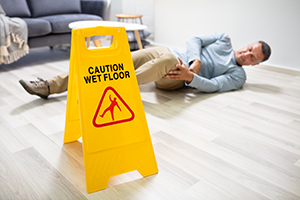 Florida Statute § 768.0755 governs a slip and fall on a transitory foreign substance inside a business establishment, and it places the burden on the injured person to prove that the business had actual or constructive knowledge of the dangerous condition and should have taken action to remedy it. Showing that a spill was there and that a fall happened does not satisfy that burden.
- Governing statute: Florida Statute § 768.0755 applies when someone slips on a transitory foreign substance in a business establishment, meaning a spill, tracked-in rainwater, or dropped produce.
- Constructive knowledge, first route: Florida Statute § 768.0755(1)(a) permits circumstantial proof that the condition existed for such a length of time that, in the exercise of ordinary care, the business should have known of it.
- Constructive knowledge, second route: Florida Statute § 768.0755(1)(b) permits proof that the condition occurred with regularity and was therefore foreseeable, which reaches a recurring hazard with no evidence of timing.
- Common-law duty survives: Florida Statute § 768.0755(2) states that the section does not affect any common-law duty of care owed by a person in possession or control of a business premises.
- Repealed predecessor: Florida Statute § 768.0710 was repealed by chapter 2010-8, Laws of Florida, effective July 1, 2010, in the same act that created § 768.0755.
- Shared fault: Florida Statute § 768.81(6) bars recovery entirely above 50 percent fault, and Florida Statute § 768.81(2) reduces the award proportionally below that line.
- Filing deadline: Two years from the date of the fall under Florida Statute § 95.11(5)(a), for causes accruing on or after March 24, 2023.
- Where cases are filed: The Eleventh Judicial Circuit in Miami-Dade County, for claims above the $50,000 county court limit in Florida Statute § 34.01(1)(c)3.
The premises liability attorneys at Friedman Rodman Frank & Estrada work from an office on South Dixie Highway in Homestead and handle falls across South Miami-Dade, from Florida City north through Leisure City, Naranja, and Princeton.
Most of the falls we see in Homestead happen in a short list of places. A grocery aisle where the produce misters have run onto the tile. A big-box entrance on a rainy-season afternoon when the mats went down late. A restaurant service doorway where staff carry trays through in both directions. What surprises people is that being badly hurt in one of those places is not, by itself, a claim. Florida law asks a narrower question than most injured people expect, and answering it depends on facts that stop existing within a day or two. Friedman Rodman Frank & Estrada has represented injured people throughout Miami-Dade County since 1976 from an office minutes from the retail corridor these cases come out of. The notice question runs through every premises claim rather than only falls, which is why the same proof issues show up in our Florida premises liability work on negligent security and stairway defects.
What Must You Prove in a Homestead Slip and Fall Case?Florida law does not make a business responsible for every fall on its floor. Under Florida Statute § 768.0755, an injured person must prove that the business establishment had actual or constructive knowledge of the dangerous condition and should have taken action to remedy it. That is an element of the claim rather than a defense the store has to raise, and it is where most retail fall cases are won or lost.
The phrase "transitory foreign substance" does the sorting. It describes something that does not belong on the floor and got there temporarily, such as water, a spilled drink, cooking grease, or soap tracked out of a restroom. A permanent feature of the property is a different claim. Cracked pavement, an unlit stairwell, or a missing handrail is not a transitory foreign substance, so Florida Statute § 768.0755 does not govern it and ordinary common-law negligence applies instead, a duty Florida Statute § 768.0755(2) preserves in express terms. Which framework applies gets decided early and changes what the evidence has to show.
Florida Statute § 768.0755 was created by chapter 2010-8, Laws of Florida, which in the same act repealed Florida Statute § 768.0710. The repealed section had let an injured person reach a jury by showing that the business failed to exercise reasonable care in maintaining the premises, without separately proving notice of the specific substance. Since July 1, 2010, notice is an element the claimant carries.
How Do You Prove a Business Knew About the Hazard?Actual knowledge is uncommon and usually accidental. It exists where an employee created the spill, walked past it, or was told about it, and somebody wrote that down. Most Homestead fall cases are built on constructive knowledge instead, by one of two independent routes.
Constructive knowledge is a legal substitute for actual knowledge. It means the law treats a business as though it knew about a hazard, because a reasonably careful business in the same position would have found it. Florida Statute § 768.0755(1)(a) permits circumstantial proof that the dangerous condition existed for such a length of time that, in the exercise of ordinary care, the business establishment should have known of the condition. The statute sets no number of minutes and no bright line, so the question is answered on the surrounding facts, and those facts are almost always physical. How far the spill had spread, whether cart wheels or shoe prints ran through it, whether the edges had started to dry, and what the store's inspection records show about when the aisle was last walked all speak to elapsed time.
Florida Statute § 768.0755(1)(b) supplies the second route, and it is the one most often overlooked. It allows a claimant to prove constructive knowledge by showing that the dangerous condition occurred with regularity and was therefore foreseeable, with no evidence at all of how long the specific substance sat on the floor. A leaking cooler case, a misting system that overflows every morning, or an entrance that floods in every afternoon storm can satisfy the statute through the pattern rather than the timeline. The two routes call for different discovery. A timeline case lives on video and sweep logs from the day of the fall; a regularity case lives on prior incident reports and vendor service records that are not limited to that date.
What Damages Can You Recover After a Fall in Homestead?Florida allows both economic and noneconomic damages in a premises case, with no statutory cap on an ordinary fall claim. Economic damages cover emergency treatment, surgery, future medical care, lost wages, and diminished earning capacity. Noneconomic damages cover pain and suffering, disability, disfigurement, and the loss of activities the injured person can no longer do. Hip and wrist fractures, rotator cuff tears, and head injuries are the common outcomes, and future care is where the real disagreement with a carrier usually sits.
Florida Statute § 768.81(6) bars any recovery by a claimant found more than 50 percent at fault for his or her own harm. Below that line, Florida Statute § 768.81(2) reduces the award in proportion to the claimant's share. A jury that values a fall case at $200,000 and assigns the shopper 40 percent of the fault returns $120,000. At 51 percent it returns nothing, which is why the fault percentage rather than the injury is what most premises cases are fought over. Punitive damages sit behind a separate gate in Florida Statute § 768.72 and are capped by Florida Statute § 768.73 at the greater of three times compensatory damages or $500,000.
Our team of attorneys has extensive experience handling these claims, so we can usually read how a carrier is valuing a Homestead fall claim before it makes any offer. The same shift-the-blame-to-the-customer theory runs through the negligent security claims we handle across South Florida, where the argument is that the visitor chose the risk rather than that the property created it.
Where a Homestead Premises Liability Case Is Filed and How It MovesFlorida Statute § 95.11(5)(a) gives a person injured by negligence two years from the date of the incident to file suit, for causes accruing on or after March 24, 2023. The period used to be four years, and a great deal of published material still says so. In Miami-Dade County, a claim worth more than $50,000 goes to the Circuit Court of the Eleventh Judicial Circuit, because Florida Statute § 34.01(1)(c)3 caps county court jurisdiction at $50,000 for actions filed on or after January 1, 2023.
The nearest court facility to Homestead is the South Dade Justice Center at 10710 SW 211th Street, which the Clerk of the Court operates as a district location for county civil and traffic matters. A serious fall case usually exceeds the county court limit and is filed downtown instead. From there the case moves through pleadings, written discovery, depositions of the store manager and the employees who worked that shift, a corporate representative deposition on inspection procedures, a defense medical examination, and mediation. Most resolve at or after mediation, and our Homestead personal injury practice follows the same track across every claim type in South Dade.
The Evidence a Florida Slip and Fall Case Turns OnSurveillance video is the most decisive evidence in a Florida slip and fall case, and it is the one most likely to disappear. Retail systems commonly overwrite on cycles measured in days rather than months. Under Florida Statute § 768.0755(1)(a), footage showing how long a substance sat on the floor before the fall goes directly to the element the claimant has to prove, and its absence usually cannot be replaced.
The store's own paperwork carries the next tier of proof. Incident reports record what a manager wrote in the first hour, before anyone knew a claim was coming. Sweep sheets and floor-care schedules establish when the area was last walked, and gaps in those logs prove as much as entries do. Vendor and maintenance records show whether a cooler, a misting line, or a roof had been leaking. Prior incident reports for the same location are the core of a case built on the regularity route in Florida Statute § 768.0755(1)(b).
The physical evidence is short-lived and mostly falls to the injured person to capture. Photographs of the substance before it is mopped, from standing height and again from floor level, fix its size, spread, and condition. Footwear rebuts an argument about traction, and weather data corroborates a tracked-in-rain theory at an entrance. Beyond the scene, these cases turn on the emergency medical run report and the treating physicians' records connecting each diagnosis to the fall rather than to something that came before it.
How We Build a Homestead Slip and Fall Case, and What to Do NowWe send a preservation letter as soon as we are retained, naming the camera positions, the date, and the hour, because a general request to save the video is easy for a risk department to read narrowly. We ask for sweep logs for the shift and the two before it, and we photograph the location at the same hour on the same day of the week so the lighting and traffic match. Then we work the regularity route alongside the timeline route, since a store that produces no video often produces years of prior incident reports for the same aisle. Friedman Rodman Frank & Estrada has handled premises cases across Miami-Dade, Broward, and Collier Counties for close to 50 years, including a $6.5 million negligent security recovery, and we advance the costs of building the case.
A fall that happens while you are on the clock is a different claim, because Florida Statute § 440.11 makes Florida workers' compensation the exclusive remedy against an employer, while a negligent property owner who is not your employer can still be sued in tort.
In the first days after a fall, a few things help more than anything a lawyer can do later. Photograph the substance before anyone cleans it, from standing height and again from the floor. Ask the manager to write an incident report and get a copy before you leave. Write down the exact aisle, department, or entrance and the time, because sweep logs are organized by location and hour and a vague description gets a vague production. Keep the shoes you were wearing, unwashed. Get a phone number for any customer who saw it, since store witnesses stop being available quickly. Ask the store in writing, that same week, to preserve the footage. And do not give its insurer a recorded statement before you have legal advice, because the questions about where you were looking are written to shape the fault percentage that decides the case.
Frequently Asked Questions About Homestead Slip and Fall ClaimsDoes a Wet Floor Sign Defeat a Florida Slip and Fall Claim?
Not automatically. A warning sign is evidence that the business knew about the hazard, which is the element Florida Statute § 768.0755 makes the claimant prove. Whether the warning was adequate is a separate question, turning on where the sign stood, whether it was visible from the direction of approach, and whether anything was done to clean up the substance itself.
How Long Do I Have to File a Slip and Fall Claim in Florida?
Two years from the date of the fall for causes accruing on or after March 24, 2023, under Florida Statute § 95.11(5)(a). Claims that accrued earlier were governed by a four-year period, which is why older articles still say four years. A claim filed after the period runs is barred regardless of how strong the proof is.
What Happens if I Was Looking at My Phone When I Fell?
It becomes an argument about percentages rather than an automatic loss. Florida Statute § 768.81(2) reduces an award in proportion to the claimant's own share of fault, and Florida Statute § 768.81(6) bars recovery only above 50 percent. Distraction is a common defense in retail fall cases, usually met with evidence about how visible the substance was.
Does Florida Statute § 768.0755 Apply to a Fall in a Parking Lot?
Only if the fall was caused by a transitory foreign substance, such as spilled oil or a dropped bag of ice. A fall caused by cracked asphalt, a wheel stop, or missing lighting is not. Those claims proceed under ordinary premises negligence, which Florida Statute § 768.0755(2) expressly leaves intact.
- Homestead wrongful death claims govern what a family may recover when a fall proves fatal, under a damages framework separate from an injury claim.
- Nursing home negligence claims cover falls in licensed care facilities, where staffing records and care plans replace sweep logs as the central proof.
- Construction accident claims reach falls on active job sites, where a general contractor may owe a duty no retail-premises statute addresses.
If you fell in a store, restaurant, or apartment property anywhere in South Miami-Dade, the video and the sweep logs are already on a clock, and we can send a demand for preservation before either one is gone. Friedman Rodman Frank & Estrada has represented injured people in Homestead and across South Florida since 1976, we advance the costs of investigating the claim, and there is no fee unless we recover for you. Call (877) 448-8585 or contact our South Dade premises liability team for a free consultation. We speak English, Spanish, and Creole.


 Your Privacy Choices